Ttareungi, for People Without a Korean Phone
Yes for day passes — the app has a Foreigner button. ₩1,000 buys unlimited one-hour hops for 24 hours. Season passes need a Korean number.
Short answer: yes for day passes, and it is the best-value way to ride in this guide. No for season passes, which need a Korean mobile number.
What it costs
| Pass | 1 hour | 2 hours | 3 hours |
|---|---|---|---|
| Day | ₩1,000 | ₩2,000 | ₩3,000 |
| 7-day | ₩3,000 | ₩4,000 | — |
| 30-day | ₩5,000 | ₩7,000 | — |
| 180-day | ₩15,000 | ₩20,000 | — |
| 365-day | ₩30,000 | ₩40,000 | — |
Non-members pay the same as members on a day pass — there is no tourist surcharge.
The bit that makes it cheap: the hour applies to each ride, not to the day. Dock the bike inside your hour, take another one, and repeat as often as you like for twenty-four hours on a single ₩1,000 pass. Overtime is ₩200 per five minutes and caps at ₩30,000; leaving a bike out beyond four hours on a standard pass, or six on the premium, is treated as loss.
Two corrections to figures still circulating. A 2023 proposal to double the hourly day pass to ₩2,000 and scrap some pass types was widely reported and never took effect — the official table still shows ₩1,000. And the three-hour day pass at ₩3,000 is new, introduced in the second half of 2025, so guides written before then do not have it.
How to rent one without a Korean phone
The Korea Tourism Organization documents the route, and it is simple:
- Install the Ttareungi app.
- Tap “Foreigner” — it is on the main screen, top right.
- Buy a pass and pay by credit card.
- Scan the QR code on the bike.
No Korean phone number, no alien registration card, no Korean bank. Minimum age is 13. You do need a data connection — a Korean SIM, an eSIM or roaming — because the app handles both the map and the unlock.
Foreign cards are widely reported to work, though declined cards are the commonest complaint, so have a second one. And the terms ask you to stay inside Seoul’s administrative boundary and return the bike to a station, which is worth knowing if the river tempts you eastward.
The season passes are where it stops. Membership signup requires a Korean mobile number. If you are here for a month, that is the wall.
What you are actually riding
A conventional city bike — sturdy, heavy, upright, and not electric. Seoul announced a 1,000-unit electric Ttareungi pilot in 2019, shelved it, and by 2023 was saying plainly that it would not pursue the idea as a matter of city policy — so any guide promising an electric version is working from a seven-year-old press release.
That matters for route planning. On the flat riverside the weight is irrelevant. On Seoul’s hills — and the city is ringed by mountains, with the interesting districts sitting above the river — it is hard work. Riders who live here say it plainly: Ttareungi on the flat, something with a motor for the climbs.
The fleet is roughly 45,000 bikes across about 2,800 stations, so finding one near you is rarely the problem.
When the hills are the point
To be clear: for the flat riverside, a ₩1,000 day pass is the right answer and we are not going to pretend otherwise. This is for the parts of Seoul that sit above the river.
Ttareungi against the rental shops
Twelve rental shops sit along the Han River — Yeouido, Ttukseom, Banpo, Jamsil, Gwangnaru and others — at roughly ₩3,000 an hour for a standard bike, ₩6,000 for a tandem, with overtime by the quarter hour. Published prices rose about ten per cent after two decades unchanged, so budget ₩3,000 to ₩3,300.
So the day pass undercuts them about threefold. The rental shops’ real advantage is the bikes Ttareungi does not have — tandems, family bikes, and the multi-seat machines that make a riverside afternoon work with children.
One seasonal catch: most close from November to February and reopen around early March, because the paths ice — though Yeouinaru and Ttukseom stay open, 11:00 to 19:00. Ttareungi runs year-round.
Taking a bike on the subway
Allowed, with rules that are more specific than most guides admit. The table below is current as of September 2026 and does change.
| Line | Weekdays | Weekends & holidays |
|---|---|---|
| Lines 1–6, 8 | No | Yes |
| Line 7 | Yes, 10:00–16:00 | Yes |
| Line 9 | No | No — never |
| Gyeongui-Jungang, Suin-Bundang | No | Yes |
| Gyeongchun Line | Yes, 10:00–16:00 | Yes |
| AREX airport line | No | No — full-size bikes banned since January 2026 |
| Sinbundang, Gimpo Gold, Ui-Sinseol | No | No |
Three rules that catch people: only the first and last carriages take bikes, and they are marked; transferring between lines with a bicycle is prohibited; and folded folding bikes are allowed anywhere, any day.
Line 7’s weekday window and Line 9’s blanket ban are the two most useful exceptions to remember.
Where to ride it
The Hangang network runs 78 km — 47.5 km on the south bank, 30.5 km on the north — inside the riverside parks and below the expressways, so it is entirely free of cars.
It is not, however, fully separated from pedestrians: about 50.8 km has a physical divider under the city’s current plan and the rest is paint and posts. The city recorded 88 accidents on the riverside paths in 2024 and has speed-warning installations at 33 sites rising to 40, with 10 km/h pedestrian-protection zones at Gwangnaru and Ttukseom.
If you want a destination, the riverside is also the start of Korea’s long-distance network: the 633 km cross-country route runs from the Ara West Sea Lock at Incheon to the Nakdong estuary at Busan, and it comes through Seoul. There is a bicycle passport with self-service stamp booths, and three of them are in Seoul — Yeouido, Ttukseom and Gwangnaru. A sticker and certificate are free; a medal is ₩7,500.
Stamping a passport booth on a ₩1,000 day-pass bike is a cheap souvenir of a 633 km route you did not ride.
Fares, fleet figures and subway rules here are from the Seoul Metropolitan Government, the Korea Tourism Organization and Seoul’s open-government portal, checked September 2026. Subway bike rules change periodically.
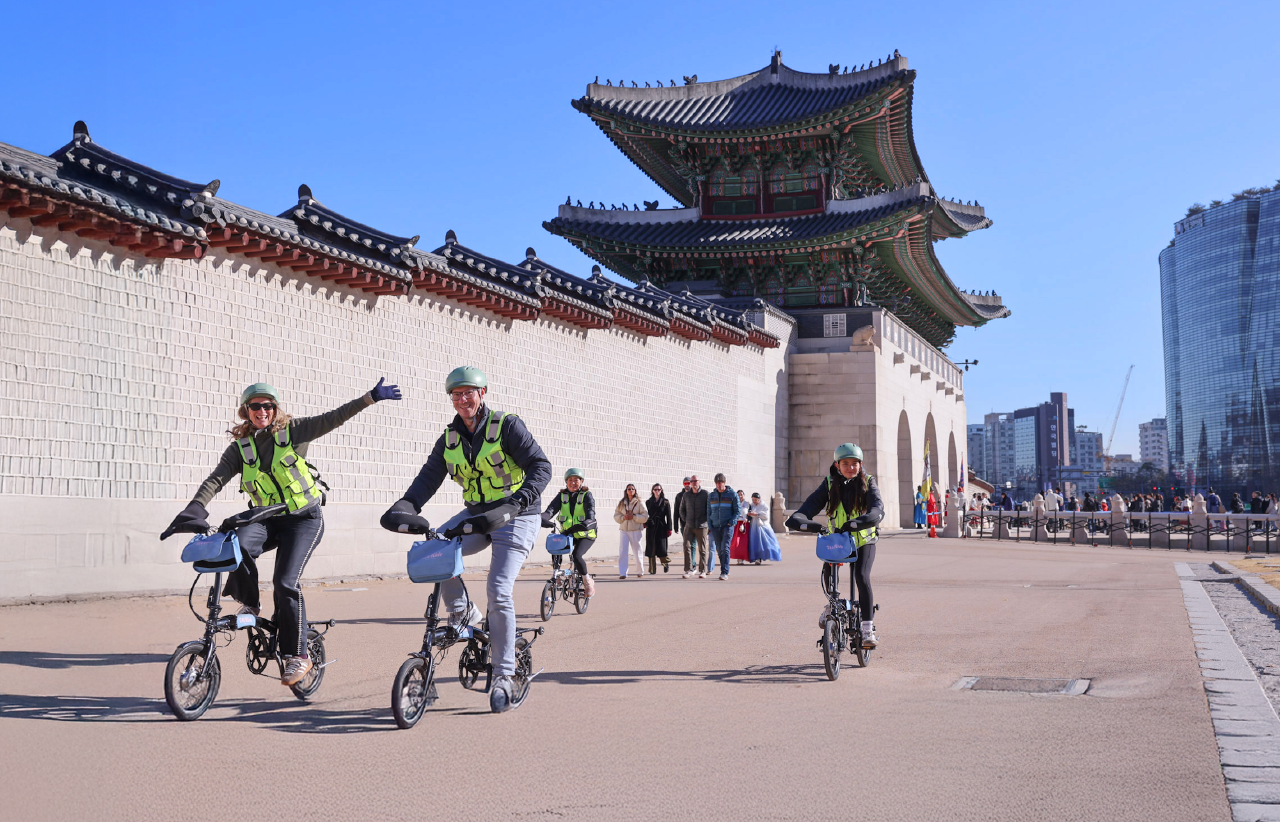
The City Highlights E-Bike Tour
An electric-assist guided ride through Seoul itself — rated 4.9/5 by 229 verified guests, the highest rating of any cycling product on this shelf. Pedal-assist means the hills behind the riverside stop being the reason you skipped them.
Check Availability & Book